
Diponegoro University successfully conducted the first two sessions of the Undip Global Classroom (UGC) on “Numerical Solution of Partial Differential Equations (PDEs)” on 12 and 19 May 2026. The lectures were delivered by Assoc. Prof. Dr. Yogi Ahmad Erlangga and attended by students and participants interested in applied mathematics, scientific computing, and computational modelling.

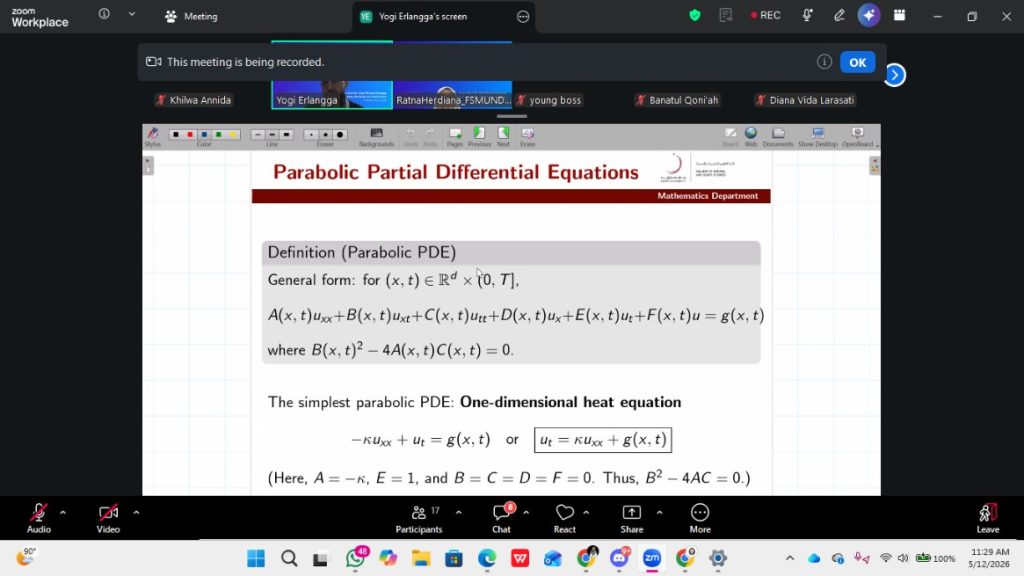
The first session focused on parabolic PDEs, which are commonly used to model diffusion and heat transfer phenomena. Participants learned the mathematical characteristics of parabolic equations and numerical discretization techniques used to transform continuous mathematical models into computable forms. Through the heat equation as a representative example, the speaker demonstrated how finite difference methods can be applied to approximate derivatives in both time and spatial dimensions, enabling numerical simulation of temperature distribution over time.
The second session discussed hyperbolic PDEs, which are widely applied in modelling wave propagation, sound transmission, and fluid dynamics. The lecture introduced the fundamental properties of hyperbolic equations and highlighted their differences from parabolic PDEs. Participants were guided through finite difference schemes for solving wave equations and observed simple numerical simulations illustrating wave movement across space and time domains.

Throughout both sessions, emphasis was placed on the importance of numerical stability, accuracy, and the selection of appropriate discretization methods to reduce numerical errors such as instability and artificial oscillations. Interactive discussions further enhanced participants’ understanding of the practical implementation of numerical PDE solutions in engineering, physics, and scientific modelling.
Through this UGC series, participants gained valuable insights into computational mathematics and its significant role in addressing real-world scientific and engineering challenges. (owa)